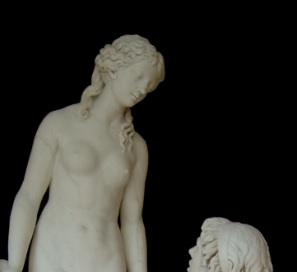

“My sweet,” she said, “as yet I am not wise,
Or stored with words aright the tale to tell,
But listen: when I opened first mine eyes
I stood within the niche thou knowest well,
And from my hand a heavy thing there fell
Carved like these flowers, nor could I see things clear
But with a strange confused noise could hear.
“At last mine eyes could see a woman fair,
But awful as this round white moon o’erhead,
So that I trembled when I saw her there,
For with my life was born some touch of dread,
And therewithal I heard her voice that said,
‘Come down and learn to love and be alive,
For thee, a well-prized gift, today I give.’”
–Pygmalion, Morris’ translation
In the series on who we are as a church, I have touched on the following aspects: the transient nature of our existence together, the proof of our Christianity to be found in our treatment of others, conflict as part of life, legacy as part of faith, a Christian morality, and the reality of our conflicting desires. These may seem like totally unrelated topics, and after reflecting at some length, I frankly have to agree. But they are no more random than our life together. Who could have predicted all the things we’ve gone through here at Holy Cross in the first year of our life? We are opening our eyes to the world around us and finding it too diverse to take in all at once, and in true child’s fashion we must select one thing at a time for scrutiny and appreciation. Some of them prick our fingers and bring the hot tears unbidden to our eyes; others delight us with the way they catch the light and reflect it back to us so joyfully; at still others we are perplexed and turn them this way and that, trying to figure them out. Someday soon we will awake to the knowledge that there is more to this world than toys to play with, and we will discover that there are actually some other children out on the playground with us. Further still down the road of spiritual maturity it will dawn on us that there is a God directing all this activity, and at the apex of this series of visions we may realize a true view of our own self; but let us take things in their proper course. This is the path we must take if we would grow slowly and strong together, just as a childlike faith is the only gateway to wisdom.
The unpredictability of our life is a sign that things are not always going our way, which is good for several reasons. First because we would probably differ on what that way ought to be, second because if we ever did settle on one it would almost certainly be the wrong one, and third because we would never continue on it once having chosen. You can persevere when you know someone else has been orchestrating your life, if for no other reason because you are cherishing that moment when you can take out all your frustrations on them when you get to the end of the line.
It is in large part this very unpredictability that makes so unpalatable the thought of how it will all end. The more alive and vibrant the music is, the greater the depth of the silence when it is over. I have been thinking much of death lately, both with the meditations on Simeon’s song and because of a recent event in a friend’s life. By the way I soundly disagree with Rick about whether Simeon was talking about his own passing, and feeling no hesitation about saying that Rick is the most gifted pastor/scholar at whose feet I have had the privilege of sitting, I feel no hesitation about saying that I think he has muffed it. When I attain the rank of “aged saint” I think death will have a different aspect to me than it does when I am thirty-three, for it will be closer at hand; and if the Spirit intimated to me that I would not taste of it until I had seen the Lord’s Christ, the words I would use to express the sweetness of my adoration for my Resurrection God would have little to do with the things of this world and much to do with those hands into which I would soon commend my soul.
I have a good buddy who lost his dad recently. Together with all his other friends I went to the funeral and mourned with him, reminiscing about times past and reflecting on the redemption that is in store for those who die in Christ. But it was moving to think about how much the old man’s life had changed in recent years. He went from a busy and well-appreciated role as a country pastor to a decline in health and activity during recent years, and one of the hardest things for my friend was seeing his father seem to change so much, and wondering what was his real personality and what was simply the hardship of his deteriorating mental health coming out. Death is at once the great unveiler and the great obscurer. It opens up to all the world who we really are, and yet when we have breathed our last and the empty shell by which everyone knew us is laid down to rest, there can be no doubt that is not who we really were.
It is because of this utter and final rending, this abrupt tearing apart of soul and body, that death brings us such grief. I was walking through the valley of this shadow with some of our extended family who recently lost a baby in pregnancy, and I can vividly remember riding in my pickup on the way back from a jobsite in southwestern Virginia. I was going through Abingdon thinking about their loss and sorrowing with them, and praying that God would give them a healthy grief to mourn their child. In this posture I was brought by the Spirit to the sudden and staggering memory of the baby my wife and I lost before Emily was born, and of my own complete inability to express either to Lynn or to my friends or to God how I was feeling through that. It was an overwhelming wave of wistful longing and deepest sadness, a piercing ray of truth into a door in my heart that has long been closed and locked. I put my head down on the steering wheel and wept unashamedly, crying for the little girl I had never been able to hold, for the hand that had never clutched mine, for the trusting eyes I would never dry from the daily griefs of childhood, for my dear Jennifer I would never know. I need not tell you what I am doing even as I write these words.
Death brings us to the brink of ourselves, and looking over the vast expanse of eternity we have need of more than just an infinite God, more than just a Maker or a Judge. We need one who has walked in our shoes, who has wept at the grave of a friend, who has felt all our sorrows and experienced the despair of bereavement. We need a Christ who is crowned with glory and honor because of the suffering of death, so that by the grace of God he might taste death for everyone. For it was fitting that he, for whom and by whom all things exist, in bringing many sons to glory, should make the founder of their salvation perfect through suffering.
It is in the knowledge that such a one is our Saviour that we can hear the words of Simeon, speaking of the rise and fall of many in Israel, and know that whatever the prophecy may betide us, it will be for our good. It is in the security of having a godly death be for us a portal, an honor reserved for those appointed to follow in Jesus’ steps, that we can feel the sting of the sword of mortality in our own hearts and take it for what it truly is: a testament to the life everlasting that is being forged in us. It is here, and here only, that we know how precious in God’s sight is the death of his saints. The word denotes something of utmost worth and expectation. It speaks out to a dying world with a mighty voice, and its message is that in quietness and trust shall be our strength, for we have a God who brings forth life from death.
There at the end of all things we shall move into his presence for the last time, for never again shall we leave it. He shall speak to us in love, and from our hand a heavy thing shall fall, and we shall be given a new and living body to love and be alive in a new and living world; and in the joy of that New Creation we shall find all our hearts have ever desired. Faces we never thought we would see again will smile up at us, a cherished hope I live in still; and in that hope I lift my peaceful prayer: Lord, now lettest thou thy servant depart in peace, according to thy word: for my eyes have seen thy salvation, which thou hast prepared before the face of all people.
JV
Artwork: Falconet’s Pygmalion

Author: Jeremy Vogan
My name is Jeremy Vogan. I live in Staunton, VA with my wife and four kids. I love to write, and seek to honestly explore the intellectual and emotional implications of following Jesus as a deeply broken person in a twisted, cruel world that is full of veiled beauty and meaning. Writing is part of how I faithfully look for Jesus Christ to someday make all things new. I'd enjoy hearing your feedback! JV



Leave a Reply