
He looked askance at Vera, and now that by declaring her love for him she had cast off the aloofness which so adds to a woman’s charm, she seemed to him, as it were, shorter, plainer, more ordinary.
“What’s the meaning of it?” he thought with horror. “But I… do I love her or not? That’s the question!”
–Verotchka, Anton Chekhov
I never thought that a dearth of imagination could be the basis for God’s criticism of my faith. My imagination has always been ten times more likely to get me into trouble rather than to stand me in good moral stead, as I push the envelope and free-associate to my heart’s content – and, it seems, to the unavoidable detriment of the orderliness of the tasks I have been assigned. It tends to run along the lines of “How can I do this differently from anyone else” and “How can I make all the parts realize their potential synergism, energy, fecundity etc. so that as a whole they work together to produce an over-the-top effect?” In whatever sphere my imagination is operating it can often be compared to Anakin twisting the throttle of the pod-racer: It’s workiiiing! It’s workiiiing! As a result of the historical results of my intellectual fearlessness in the face of conventional caution, the cost of the collateral damage often seems to outweigh the value of the result, making me hesitant to adopt it with anything at all of value.
But it should not be surprising that God is interested in redeeming every part of our being, because where else would I have gotten my own affinity for holistic integration? So when we hear with the Corinthians that our vision of life after death is not so much errant as it is insipid (we hear “resurrection” and we think about revived corpses, not about the attenuation of the weakness of our mortal bodies into that eternal frame of existence which cannot but seem hypersomatic from where we now stand), our thoughts should not run instantly to the difficulties we have always seemed to get ourselves in by turning to the right side of the brain. Instead we must allow our mind’s eye to fill with the vision of a new kind of development – one that builds up instead of tearing down, that is geared toward beneficent dominion instead of careless empire.
To make this shift we need to be informed by a new wisdom. It goes without saying that there is more required of a truly Christian imagination than the boy-racer foolishness of the young at heart (a source of unavoidable misfortune with which in my 33 years I have become well acquainted, having wrecked a motorcycle and rolled a 4-wheel-drive or two in my day). That kind of bravery is built on nothing more than will, and nothing more than the unforgiving impact of reality is required to reduce it to regretful memory. If our salvation depends not on human will or exertion, but on the mercy of God, we need that mercy in the form of knowledge.
The Gospel does not reply to this question, for such a posture would presume that the question came before the answer. God’s Word has told us the truth about who we are since before we even knew to ask. The Spirit as he hovered over the waters of the deep unfurled the portrait of Creation for us, and he did so for the purpose of showing us where we came from. And it seems like a lot of fanfare for a very little thing when we see what our origin actually was. Dust you are and to dust you will return, says the voice of God, and we shudder at the word, for in it we hear the death-knell of the physical existence we try so hard to maintain.
That is because we know that life abhors a decline. We are at the top of the pyramid of Creation, and we reject any suggestion that we are no longer qualified to be there; for did not God himself put us there? We are lords over all that is made, and the smoke of our petty despotism rises before the halls of Heaven as we tell ourselves that lie. We said in our heart, “I will ascend to heaven; above the stars of God I will set my throne on high; I will sit on the mount of assembly in the far reaches of the north. It is in our fallen human nature to look at that which we were created to love, and to need to stand above in order to engage with it.
If the Gospel was faithful to tell us where we came from, it is also faithful to tell us where we now are. It proclaims that we have indeed exalted ourselves, and that we had no business up on that summit. Man was created to live in the fields, tending the living garden and caring for all that moves on the earth, and it is a blasted and desolate place we have chosen for our dwelling now. How you are fallen from heaven, O Morning Star, son of the Dawn! How you are cut down to the ground, you who laid the nations low! The penalty for climbing up out of Eden is to be exiled to the valley, and it is a barren one. But it is down there, and only there, that we are finally given a glimpse of ourselves.
And it is a heartbreaking moment. Another person can love me fairly easily when we see each other from afar off. From a mile away it looks like everything is OK, and we each have our lives figured out, and things are trotting along very nicely, and nothing ever comes between us and our fondest desires. We don’t mind that the other thinks that either; it comes in very handy when we don’t feel like working on our relationship. But when we move closer together all the problems show up in fine detail. Everything is not OK, and our lives are a complete mess, and things crash and burn daily, and in vain we spend our lives chasing after everything that the pagans do. And we declare that we love each other, and each of us turns aside in horror and asks the fateful question: “Is there really love between us?”
Frightening though it is, this is the place where God would have us begin. The point of the involvement of our imaginations is not to stand us in good moral stead, any more than the point of working for our bread is to keep us from ever dying. It is to sharpen our perspective on the power of the God we serve. A God who hates sin can crucify us to it every day, and yet be creating something within us that will live forever in holiness. A God who did not let his Holy One see decay can preserve the glory and vitality of the relationships we have so that in redemption they will not be destroyed, but rather enhanced. A God who has triumphed over death and Hell can wrap up our identity in a new man, one who did not ascend to the heights to claim his rights but who instead descended to the depths to claim his own.
I believe this truth. I believe it to the point that I am (I hope) willing to lay down my life for it, and what is more important, to lay down my life for those who walk along with me in it. And I know there is no more important time than right now for us to lay hold of this. God be willing, Holy Cross will become a particular church this year. Even now we are moving closer together, and seeing more and more of each other on Sunday and through the week. We love each other, God knows we do, but we are starting to see the ugly side of our humanity as well. Evil thoughts, sexual immorality, theft, murder, adultery, coveting, wickedness, deceit, sensuality, envy, slander, pride, foolishness. If you do not yet know which of these are a true account of my heart on a daily basis, it is only because you do not yet know me well enough. There are a few here who do, and it is because of their tears and prayers on my behalf that I continue in the Gospel today. And it is because through them Jesus can still love me, that I have hope for the future.
For the principle of godliness is not to ascend on the bodies of others. Jesus made himself nothing, taking the form of a servant, being born in the likeness of men. He took our sins upon him and he descended into Hell, and for a space it appeared that he had fallen beyond hope of ever rising again. But our creed tells us that on the third day he rose from the dead, and ascended into heaven, and that he sitteth on the right hand of God the Father, and that he will come again to judge the quick and the dead. If Adam took physicality and its temporal manifestation as that possession which at all cost must not be lost, going to the fullest possible extent to try to hold onto it, Christ took physicality and its eternal manifestation as that gift which at all cost must be received, going to the fullest possible extent to let it go. And he did this so that, in following him down to the depths of suffering on each other’s behalf, we might together be the recipients of that gift which is beyond all imagination.
Beloved brothers and sisters at Holy Cross, this is how the perishable puts on the imperishable, and how the mortal puts on immortality. This is the saying that shall surely come to pass, Death is swallowed up in victory.
JV
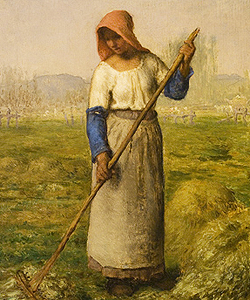
Artwork: Peasant Woman Raking, Francois Millet

Author: Jeremy Vogan
My name is Jeremy Vogan. I live in Staunton, VA with my wife and four kids. I love to write, and seek to honestly explore the intellectual and emotional implications of following Jesus as a deeply broken person in a twisted, cruel world that is full of veiled beauty and meaning. Writing is part of how I faithfully look for Jesus Christ to someday make all things new. I'd enjoy hearing your feedback! JV




Leave a Reply