

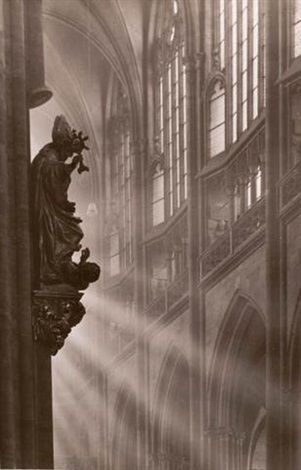
Never in peace or war have I seen so vast a concourse. There were tens of thousands of them, all silent, every face watching me. Among them I saw Batta and the King my father and the Fox and Argan. They were all ghosts. In my foolishness I had not thought before how many dead there must be. The faces, one above the other (for the place was shaped that way) rose and rose and receded in the greyness till the very thought of counting – not the faces, that would be madness – but the mere ranks of them, was tormenting. The endless place was packed full as it could hold. The court had met.
–Till We Have Faces, CS Lewis
Coming off one of the most intense experiences of my life at our church’s men’s retreat this weekend, I am trying to sort out my thoughts without very much success. Much of what I want to explore (thoughts on calling, thoughts on free grace, and most importantly of all, thoughts on revival) is going to take more time to process. But what presents itself for expression right now is more meditation along the lines of togetherness.
Maybe it is because I am a “people person”, but I have always taken the measure of every situation by those who were involved in it. From the unwitting immaturity of my adolescence I have progressed to a measure of perception sufficient to realize that I am fundamentally immature, but this has not served to change much about how I view people. Certain of my friends can be shown to have quicker wit than others, better taste, more fully developed cultural awareness, a more sensitive intuition, a closer affinity to those patterns which I suppose to appear most clearly in my own personality: all these I tend to gravitate to because I remember the keenness of the experiences we have had together, and I want that again. It is a desire reducible to simple relational greed, an insatiable desire to glut my senses with social subsistence that is taken far beyond what I need for a healthy enjoyment of what fellowship was meant to be. And it has long been my criterion for the estimation of the value of time spent, both in thinking about events in the past and anticipating events in the future.
The best example I can give to explain this tendency is that of seasoning. We all know the difference between a meal that is flavored well and one that is not. As I am not a dietician I will not insist too strongly upon the actual truth of this statement, but will simply put it out there as my understanding of the way things are. I think there is no substantive difference between a meal that is provided with the finest of herbs and garnished around with all that green stuff you’re not really supposed to eat and tinctured with just the right amount of salt to bring out all the flavors, and a plate of meat and potatoes and beans that is adorned only with the austere presentation of what you need to get you through the day. It is not as if we receive any more nourishment from the heightened ability to appreciate good food, any more than we are warmer if we are sitting looking at the fire than if we are sitting facing the other direction (even though it feels like it). But when I am with some people it seems that everything is sharper, brought into clearer focus and more pleasing to my palate.
I am not saying that taste is immaterial. Or, if I am saying that it is immaterial, I am not saying that it doesn’t matter. God knew that a perfect world without beauty would be uninhabitable – much less a broken world. To receive this as a gift from his hand and enjoy it not so much for what it is, as for what it points to, is one of the sweeter aspects of Christian life. But I have found that when I insist upon receiving the same portion of it, over and over again, with ever-increasing frequency, it begins to lose its savor – like watching replays of the same sunset into infinity. And it is when I exclusively choose to associate with those of my friends with whom I feel the most alive, that the fullness of life itself passes me by.
For the nature of my problem, as is so often the case, does not lie in my own preference. There is nothing intrinsically wrong with that. It lies in my reluctance to perceive the whole image of God as it is borne out by the whole spectrum of those he has placed around me, and in my unwillingness to enter into their lives. If I truly saw the love of God in that gesture of mercy that went unnoticed by mortal eyes, if I knew that God was sovereign because people’s lives were being ordered so magnificently around me, if grace burst on me with the glory of the quiet moment when one child of God says to another “I forgive you”, if I could appreciate the depth of leadership that takes place when a Christian brother stoops to serve another, if I could wonder at a sister welcoming into fellowship those who have none – if I could back up and see this mosaic unfolding in the simplistic complexity of all its rich portrayal of what God meant humanity to be, I would never again limit myself to such a narrow experience. I would jump at the chance to know what God is doing in some person’s life whom I have never met before, and would there discover a sweetness I had never tasted before.
The message of the Gospel to me is not that I am too greedy: it is that I am not greedy enough. It dashes to the ground the little example I shared earlier of seasoning vs. non-seasoning, and it tells me that to see what God is doing in the people around me is an acquired taste that I would do well to seek after. The Gospel says that many will come from the east and the west and recline at table with Abraham, Isaac and Jacob in the kingdom of heaven; and it will probably not be who I think. And it says that I need to see what is going on in their lives so that I may strive for peace with everyone, and for that holiness without which no one will see the Lord. And once having had my eyes opened to that which no eye has seen, nor ear heard, nor the heart of man imagined, I will not be content until the day when I discover what God has prepared for those who love him.
If we truly believe that we are the sons and daughters of God, placed together in church families by his sovereign hand, given work to accomplish and conflicts to work through and burdens to bear and joys to savor and sorrows to weep over and souls to win – if all these things are true, is it conceivable that this could happen in the selective confines of my natural partiality? That very thought does not bode well for my own interests, for it must be that I would also be excluded by the partiality of many of my brothers and sisters. But if it is a calling greater than we can fathom, it must be given to a multitude of people. Jesus must be planning to ride to the winepress of the fury of the wrath of God Almighty at the head of a countless host. And it is our very diversity that will be our greatest testament to the Father who gave us life.
A day of reckoning is coming. It is that day of which John spoke when he said that there was a mighty Book of Life, and that the dead were judged by what they had done. It is a passage that gives us Reformed thinkers some amount of heartburn because we know (I believe rightly) that Christ will be our righteousness in the sight of the Law. But if Christ is our righteousness, does that not mean that in him we now have the freedom to keep the Law? And is not loving our neighbor one of the greatest expressions of this freedom? GK Chesterton once that said God phrased it that way for a very good reason, because it is really easy to love the heathen in Africa you’ve never met, while it is almost impossible to love the jerk next door whom you see every day. If at the end of all things, then, we are to be found in Christ, it is to be expected that we will have done the things he did. When I stand in front of that great court the question will not be, “Were you a good person?” We all know the answer to that, and it is not a good one. Instead there will come before the Judge a great host of faces, the people I lived my life with and who shared my little corner of the planet. And in them will be found the proof of my Christianity.
In that most honest moment of my existence I will cry out, Lord, when did I see you hungry and feed you, or thirsty and give you drink? And when did I see you a stranger and welcome you, or naked and clothe you? And when did I see you sick or in prison and visit you? And all my greatest hopes and fears will hang on his answer; but with the love of Calvary in his eyes the King will answer me, Truly, I say to you, as you did it to one of the least of these my brothers, you did it to me. This is the calling we have as the family of God.
JV
Photo credit: http://www.Shutterstock.com

Author: Jeremy Vogan
My name is Jeremy Vogan. I live in Staunton, VA with my wife and four kids. I love to write, and seek to honestly explore the intellectual and emotional implications of following Jesus as a deeply broken person in a twisted, cruel world that is full of veiled beauty and meaning. Writing is part of how I faithfully look for Jesus Christ to someday make all things new. I'd enjoy hearing your feedback! JV




Leave a Reply