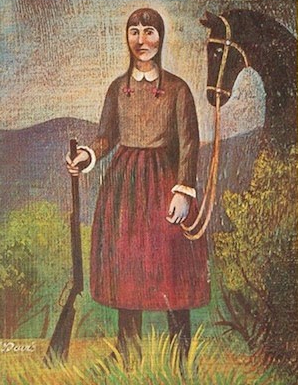

[Rooster] “Bo was about played out and I hollered up for that Hutchens to come help me. He was sitting up there on his horse smoking a pipe. Now, he wasn’t a regular drover. He was from Philadelphia, Pennsylvania, and he had some interest in the herd. He said ‘Do it yourself. That’s what you are paid for.’ I pulled down on him right there. It was not the thing to do but I was wore out and hadn’t had no coffee. It didn’t hurt him bad, the ball just skinned his head and he bit his pipe in two, yet nothing would do but he would have the law…”
–True Grit, Charles Portis
Conflict is the mark of life. One has only to look for the places on this planet where it is evident that in some measure a struggle is going on, to know where in the same measure growth and vitality may be found. This seems disparate, and it can probably be successfully argued that it was not that way before the Fall, but for us living in a broken world that thought is ultimately inconsequential. We are born fighting for the very air we breathe, and we die reaching for that last breath again, and every moment in between is spent competing for something: life, love, resources, escape, preferment, distinction, sensation, regard. To compete with the elements is one thing, forcing the world around us into the grid of our calling; to compete with one another, and specifically to one another’s detriment, is another matter entirely. At that point we have made the shift from God’s benevolent Fill the earth and subdue it, to our own insolent Am I my brother’s keeper?
But it is the overwhelming regularity of this occurrence that forces us to consider its implications. Point out to me a relationship that does not include conflict (husband-wife, friend-friend, parent-child, brother-sister, boss-employee, pastor-parishioner), and I will show you one that is dead. It is truly a common denominator and as such we must gauge our connections to others by its presence or absence.
The commonality of this aspect of life does not serve to effectively baptize it, however. Conflict is by nature destructive, and that destruction is not always indicative of progress. Here I cannot help but think of roller hockey. I love roller hockey, and used to play it with the kids on my street in Louisiana. Inevitably I would come home bruised and battered, but always having had a blast. One incident in particular I recall when I was playing with my brother and some other friends in a big parking lot. He and I both went for the puck at the same time, barreling down the field in converging lines at full throttle. Neither of us swerved away, but for some reason I dropped my shoulder at the last minute, which was a huge mistake. We collided and I received the worst shoulder sprain I’ve ever had in my life. I had to drive my motorcycle back home with one hand (something of a feat in itself) and it was weeks before I could use my left arm again. Although I enjoyed the puerile glory of the injury, it is difficult to think of good that came from it.
This raises the question of what makes conflict productive in the Christian life. If pain were meritorious in a flagellating sort of way we could make a rather good case for random acts of discord calculated to provide everyone with sufficient anguish to ensure our continual sanctification, but we know that is not the case. Pain is an indicator that something is wrong, whether it be physical or emotional or spiritual, and is certainly not a guarantee that you are following the right path. We had better be asking ourselves whether the pain is the result of a follower of Jesus struggling with the world at large, or whether it is merely because we have inadvertently stuck our head in a pot of boiling water. Common sense can usually sort this one out without much help.
Once we have determined that conflict is causing pain within the context of our life as a church, however, we need the Scriptures to inform its development. We need to know whether the destruction that will always accompany it is going to bear fruit for us or not, so that we can choose how we are going to respond to the conflict: that is, whether we should retreat from it in the wisdom of self-preservation or move into it in the pursuit of real life.
Jesus warned his church against ravenous wolves, masquerading in sheep’s clothing. I think I have always imagined this as a distinct, discrete, quantifiable set of people with a secret tag in their shirt that says “Wolf” on it. If you could only figure out the folks who are the closet wolves you could have the edge on them, because then you could stop them at the door and proudly unveil their intrinsic lupinity for all the world to see. Your perceptiveness would be appreciated by all, and all the other sheep would come trotting over to put their shoulders against the door to keep the beasts out, and the battle would be set for success from the very beginning. But this trick is too neat to be true of humanity, and it is too narrow for the Gospel. The reality is that Jesus’ words are for every one of us at different points in time. He also described these ravenous wolves as “false prophets”. This hearkened back to a day when there was no Bible as we know it, and when the measure of a preacher’s words was the accuracy of the prefix Thus saith the Lord. If what a prophet said came to pass, his message was of God; if it did not, he was to be done to death. It was a tenuous system at best, and at its worst was vicious. And it is the system in which by the instruction of Jesus we find ourselves. If they are wolves who speak falsehoods to their brothers and sisters in the name of the Lord, I am surely among them. For who has spoken truth all the time? And my own greatest source of sin is what comes out of my mouth.
Conflict is bitter, raw and violent. It is the latent potential for anger that is spun up into incipient rage when someone presses our buttons. And in this we are not entirely on our own, for we are made in an Image. In the book of Numbers God’s wrath was kindled against his people, and he made this complaint against them: Hear my words: If there is a prophet among you, I the LORD make myself known to him in a vision; I speak with him in a dream. Not so with my servant Moses. He is faithful in all my house. With him I speak mouth to mouth, clearly, and not in riddles, and he beholds the form of the LORD. Why then were you not afraid to speak against my servant Moses? God was so angry at Miriam and Aaron for their slanderous attempt to depose Moses (the more reprehensible because Moses was not really the one in charge), that after he blew his stack in a demonstration of divine fury and smote Miriam with leprosy, the Biblical historian tells us that he simply departed. For fear of irreverence I am hesitant to describe the Almighty as leaving in a huff, but he is the one who preserves his Word for us and I don’t know any other way to read that story honestly. Take a look sometime at a picture taken with a radio telescope of Messier Object 42, and it might give you an idea of the corner of the galaxy God goes in to blow things up when he gets mad.
But if the fact that God is our Father contributes to the way we respond to things that anger us, his example must also be the one we look to as we seek to bear fruit with our conflict. When Moses cried out to God to redeem his sister from a disease that spelled death, you could almost see the tears standing in the eyes of Jehovah as he moved back into the sphere of his children to comfort them. And it was their unchanging relationship that God held out as the assurance of his intent toward them; for he likened the event to a father spitting in his daughter’s face. It was shameful, but he was still her father. Trust had been betrayed and closeness shattered, yet after the heat of the argument the family always comes back together again.
I loved the light Rick shone on the gifts of the Spirit last week, and I want to look at conflict in this same way. The violence of the encounter and the daunting prospect of picking up the pieces afterward ought not to be the way I know that God is among us in our little feuds. If Jesus receives the glory for it, and if the Church receives the benefit from it, we must believe that it is of the Holy Spirit. And the implications of that are the same as for spiritual gifts, for if the war we are called to is a holy one and we shrink back from it, God will not be pleased. But we are not of those who shrink back and are destroyed, but of those who have faith and preserve their souls.
JV
Artwork: Cover, True Grit, 1968 edition

Author: Jeremy Vogan
My name is Jeremy Vogan. I live in Staunton, VA with my wife and four kids. I love to write, and seek to honestly explore the intellectual and emotional implications of following Jesus as a deeply broken person in a twisted, cruel world that is full of veiled beauty and meaning. Writing is part of how I faithfully look for Jesus Christ to someday make all things new. I'd enjoy hearing your feedback! JV





Leave a Reply